
Bookkeeping
-
How To Find Total Assets On Balance Sheet
Understanding the equity accounting formula is essential for investors because it helps them evaluate the true value of their investments. Equity numbers come from the income statement and end up subject to certain stipulations within the budget code. Return on common equity (ROCE) is a calculation made by calculating the ratio of (net income – preferred dividend value) / (average common equity). The return on common equity formula should be reasonably easy to calculate if the right numbers are available. To take these numbers into additional calculations, it’s important to have the records of monetary transfer at hand.

Subtracting Liabilities from Assets
When it is used with other tools, an investor can accurately analyze the health of an organization. Shares are small pieces of your company that are worth a certain dollar value. If you total up the value of all the shares you own, that’s your total stock in the company. You may notice that dividends are included in our 10-column worksheet balance sheet columns even though this account is not included on a balance sheet. There is actually a very good reason we put dividends in the balance sheet columns. Unearned revenue had a credit balance of $4,000 in the trial balance column, and a debit adjustment of $600 in the total equity formula adjustment column.
My Account
- Shares are small pieces of your company that are worth a certain dollar value.
- Rearranging the accounting equation helps in understanding equity accounting better.
- Net sales is the gross amount of Sales minus Sales Returns and Allowances, and Sales Discounts for the time interval indicated on the income statement.
- Get free guides, articles, tools and calculators to help you navigate the financial side of your business with ease.
- The accounting equation helps to assess whether business transactions carried out by the company are being accurately reflected in its books and accounts.
We’re a headhunter agency that connects US businesses with elite What is bookkeeping LATAM professionals who integrate seamlessly as remote team members — aligned to US time zones, cutting overhead by 70%. Because Anne’s mom’s stock is preferred stock, she gets first dibs on the dividend. She’s entitled to $5,000 of the dividend, leaving Anne and Alex to split the rest. Notice how Anne & Company sold Anne’s mom a special kind of stock called preferred stock.
- Negative brand equity is rare and can occur because of bad publicity, such as a product recall or a disaster.
- The calculation includes information from the company’s balance sheet; it can be difficult to pinpoint the accuracy of depreciation and other factors.
- That’s why so many professionals or workers seek to get employed by foreign companies or multinationals that offer greater opportunities for career growth.
- In total, this question pertains to the structure of the income statement.
- If you own a partnership with someone, you probably agreed to split the owner’s equity with one or more of the partners in percentage terms.
How is the Balance Sheet used in Financial Modeling?
It is calculated by subtracting total liabilities from total assets of the company. This statement is a great way to analyze a company’s financial position. An analyst can generally use the balance sheet to calculate a lot of financial ratios that help determine how well a company is performing, how liquid or solvent a company is, and how efficient it is.
Limits of the Accounting Equation
- The borrowed money will be reflected in its balance sheet as both an increase in the company’s assets and an increase in its loan liability if a business takes a loan from a bank.
- The larger and more complex a company is, the harder it is to determine WACC.
- The remaining amount is distributed to shareholders in the form of dividends.
- Retained earnings are part of shareholder equity as is any capital invested in the company.
- Sales are reported in the accounting period in which title to the merchandise was transferred from the seller to the buyer.
- In finance, equity is the market value of the assets owned by shareholders after all debts have been paid off.
- With this solid equity base, the company can expand, take risks, and generate investor confidence.
While analyzing current assets gives you a good estimation of the total assets, it’s important to consider the composition of the total assets as a whole. Non-current assets, which are discussed in the next section, also contribute to the total assets value and provide insights into a company’s long-term growth potential. In the next section, we will explore another method, using financial ratios, to estimate the total assets on the balance sheet. The sum of the current assets and non-current assets will provide an estimation of the total assets value. However, it’s important to note that this approach assumes that all assets have been correctly accounted for and valued on the balance sheet. Once you have determined the value of the current assets, you can focus on analyzing the non-current assets.
Understanding the Balance Sheet

As a fund moves through these steps, its total amounts after each calculated situation resolve themselves into a more limited fund. This is the value of funds that shareholders have invested in the company. When a company is first formed, shareholders will typically put in cash. Cash (an asset) rises by $10M, and Share Capital (an equity account) rises by $10M, balancing out the balance sheet. The most liquid of all assets, cash, appears on the first line of the balance sheet.
Case Study of Liability Impact on Equity
The result of the sale of an asset for less than its carrying amount; the write-down of assets; the net result of expenses exceeding revenues. The current asset that represents the amount of interest revenue that was reported as earned, but has not yet been received. Using the amounts from above, the ABC Corporation had free cash flow of $31,000 (which is the $126,000 of net cash provided from operating activities minus the capital expenditures of $95,000). If dividends are considered a required cash outflow, the free cash flow would be $21,000. Net income is also one component of a corporation’s comprehensive income.
How is the balance sheet valuable formula for financial analysis?
Perhaps the most common type of equity is “shareholders’ equity,” which is calculated by taking a company’s total assets and subtracting its total liabilities. If positive, the company has enough assets to cover its liabilities. If negative, the company’s liabilities exceed its real estate cash flow assets; if prolonged, this is considered balance sheet insolvency. Typically, investors view companies with negative shareholder equity as risky or unsafe investments.
-
Difference Between Fixed Cost and Variable Cost with Example and Comparison Chart

High volumes with low volatility favor machine investment, while low volumes and high volatility favor the use of variable labor costs. Understanding the fixed and variable costs your startup bears is crucial to calculating your break-even point. Semi-variable costs tend to have a fixed component up to a certain production level, with a variable element kicking in as production surpasses that threshold. For example, if you’re manufacturing a physical product, then the cost of raw materials will be a variable cost. If you sell more widgets, you’ll need to buy more widget components, and so the variable cost of raw materials increases.
How to Reconcile Expenses in Minutes, Not Days

Total costs are composed of both total fixed costs and total variable costs. Total fixed costs are the sum of all consistent, non-variable expenses a company must pay. For example, suppose a company leases office space for $10,000 per month, rents machinery for $5,000 per month, and has a $1,000 monthly utility bill. Both fixed and variable costs are important metrics to understand when running your business.
Financial Analysis and Performance
This metric is used to calculate the break-even point and to set prices that will meet all financial obligations and generate a profit. The first step in calculating her total monthly fixed costs is to break down each cost into its monthly amount. Total fixed costs are the number you get when you add up all the fixed fixed vs variable costs costs you need to pay to keep your business running, regardless of your overall sales numbers. Variable costs are the costs of production that do vary with the level of output produced. For example, input costs, packaging costs, inventory costs, wages, etc. Selling, general and administrative expenses include all costs that are non-production.

COGS vs operating expenses in SaaS

A bakery pays $2,000 in monthly rent for its space, whether it sells 100 cakes or 1,000 cakes. If the bakery earns only $1,500 in revenue during a slow month, it still needs to cover the $2,000 rent, creating a cash flow deficit. Suppose the bakery took a loan to buy an industrial oven, with monthly repayments of $1,500. These payments remain constant whether the oven is used for 100 hours or sits idle. Knowing the difference between the two helps businesses predict cash flow, determine pricing strategies, and manage expenses effectively. Another example is a retailer that doubles its typical order to prepare for a holiday rush.

Stay updated with Fyle by signing up for our newsletter
The difference between a step-variable cost and a step-fixed cost has to do with the width of the range of activity. If the total cost increases with small increases in activity, it may be referred to as a step-variable cost. If the total cost will change only with large increases in the quantity of activity, the term step-fixed cost is more likely to be used. The company faces the risk of loss if it produces less than 20,000 units. However, anything above this has limitless potential for yielding benefits for the company.
- Variable costs are the costs of production that do vary with the level of output produced.
- In other words, semi-variable costs possess qualities of both fixed and variable costs making them an important concept to understand in the broader context of cost behavior analysis.
- All types of companies have fixed-cost agreements that they monitor regularly.
- Variable costs are generally direct costs in that they relate directly to the production of goods or services.
Accounting Services
Variable ledger account costs, on the other hand, fluctuate with changes in production volume. Understanding the distinction between fixed and variable costs is crucial for making informed decisions within a business. Fixed costs are expenses that stay the same, no matter how many goods or services a business produces. These include rent, insurance, salaries, and any contracts with fixed payments.

Direct Costs vs. Indirect Costs
Due to the nature of variable costs, they can change from month to month or person to person. Below are some of the more common examples of variable expenses you might include in your budget. When you run your own business, you’ll have to cover both fixed and variable costs. For some businesses, overhead may make up 90% of monthly expenses, and variable 10%. Businesses can use financial data to analyze their cost structures and make informed decisions.
Most common fixed costs included in the cost of goods sold are equipment depreciation costs and salaries for personnel responsible for product quality. The total variable cost is the quantity of output multiplied by the variable cost per https://www.bookstime.com/ unit of output. A stepped cost is also referred to as a step cost, a step-variable cost, or a step-fixed cost.
Fixed Cost vs. Variable Cost
Variable costs are flexible, so analyze spending patterns and identify areas to save. Starting a nonprofit can be a fulfilling way to make a difference in the community, but it requires careful planning and consideration. Now, from the discussion mentioned above, it might be clear that the two costs are perfectly opposite to each other, and they are not the same in any respect. There are many doubts while we talk about these two, but with this article, you will surely be satisfied. So, this is all for the difference between Fixed Cost and Variable Cost.
-
100+ QuickBooks Online Courses for 2025 Explore Free Courses & Certifications
Now, we have arrived at the last QuickBooks online course on our list. On Skillshare, there is no one best course, but a couple of online courses for QuickBooks, which caught our eye. As a matter of fact, if you search through the platform, you can find a course for every skill level and experience. CSI Workforce offers hands-on classes, many of which are designed as preparation for more in-depth classes at the college’s learning labs.
QuickBooks Training class Columbus
- Expert instructors conduct the classes, so there are no worries about the content quality.
- This course is led by Bob Steele, who is not only an experienced user of QuickBooks but has spent most of his career in schools and adult education, figuring out the best methods of teaching.
- You can become an Intuit-certified QuickBooks user by taking an exam.
- If you want a certification for your work, you need to purchase an annual CFI membership.
This course is led by Bob Steele, who is not only an experienced user of QuickBooks but has spent most of his career in schools and adult education, figuring out the best methods of teaching. Learn QuickBooks, earn certificates with paid and free online courses from Mt. San Antonio College, Foothill College, Santa Barbara City College, Chaffey College and other top universities around the world. Expert instructors conduct the classes, so there are no worries about the content quality. With these subscriptions, you can access many other QuickBooks courses online quickbooks classes and online essential training sessions. QuickBooks Online course is another beginner-level QuickBooks paid course offered by Simon Sez IT.
How long does it take to learn QuickBooks?
Fit Small Business is one of the free QuickBooks online training courses. It is suitable for beginners and people looking to improve their QuickBooks skills. Learn how to keep the books for the Healthcare and Assisted Living industries using QuickBooks. Record income and patients, receive payments, organize and set up lists, record adjustments and additional patient transactions, record costs, track classes, and use payroll. Learn to use QuickBooks Desktop to meet your unique needs in the manufacturing & wholesale industry. Organize your business data, learn everyday money in and money out transactions, understand quotes, deposits, and sales orders, learn accounting tasks and procedures, and save time along the way.
- The lessons are taught by Mark Smolen, who has two decades of experience in computerized accounting.
- The courses provide training on the more extensive parts of QuickBooks Online, including bank reconciliations and VAT returns.
- Attend this live Quickbooks training class from your own location or any of ONLC’s centers for an interruption-free learning environment.
- When you enroll for live classes, you get a voucher for one certification.
Learn QuickBooks on any schedule
See the career pages for more information on required skills, tips for landing a job, typical day-to-day work, and where to find job postings. We combine a lightning-fast interface with instructional content developed by tutors from Berkeley and Stanford to build the richest educational experience possible. Our App-driven Online Tutoring system helps students and parents succeed in the SAT and ACT tests in the most engaging and effective way possible.
QuickBooks Training class Ontario
You can enroll for free in many of CFI’s courses to complete the trainings. If you want a certification for your work, you need to purchase an annual CFI membership. ONLC’s Group Training solutions offer an efficient and cost-effective way to upskill your staff in QuickBooks Online and QuickBooks Desktop. Our training sessions can be tailored to your needs, available both publicly and privately with options for onsite or online instruction. When you pass a certification exam, you’re certified for LIFE! You can also filter classes according to related skills and duration to get the most precise result.
So this is a great option if you want to take your online accounting further. Getting the hang of accounting software sounds difficult, but don’t fret – we’re going to dig into the best way to learn how to use QuickBooks. I’ve looked at all the options available and chosen the ten best QuickBooks courses. NYIM Training also offers the QuickBooks Online Level I course, which provides lessons on accounting software’s fundamental functions, including working on bookkeeping and taxes. UCLA Extension is the best for QuickBooks online college classes. The online courses allow you to interact with the instructor and other learners.
Noble Desktop is today’s primary center for learning and career development. Since 1990, our project-based classes and certificate programs have given professionals the tools to pursue creative careers in design, coding, and beyond. Noble Desktop is licensed by the New York State Education Department. We’ve chosen 6 of the best QuickBooks courses from the top training providers to help you find the perfect fit. Bob Steele, an instructor with a 4.4/5 star rating, conducts the lessons.
Earning a QuickBooks certification demonstrates your proficiency, making you more attractive to employers seeking skilled bookkeepers, accountants, and financial managers. Certified QuickBooks users often have an edge in securing roles in small businesses, accounting firms, and as freelance bookkeepers. Certification can lead to better job opportunities, higher earning potential, and the confidence to manage finances effectively. For careers in accounting or financial management, QuickBooks certification is a valuable investment. And with Single + Certification and Team + Certification, each user also gets three QuickBooks Certified User exams ($390/$1950 value) and certification prep materials.
No, you do not need to be an expert in accounting to learn QuickBooks courses. She is a software trainer and a QuickBooks consultant with decades of expertise. This course has many positive reviews and a rating of 4.5 out of 5. Hector Garcia is a certified QuickBooks advisor, CPA, and consultant. He creates a series of webinars to teach QuickBooks software to people in different industries.
QuickBooks Online has become one of the most popular accounting software packages for new and small businesses. If you’re certified, you’re better positioned to apply as a highly qualified job candidate who can validate your QuickBooks knowledge and skills. And with our Live QuickBooks Help, you can get the assistance you need to learn as you work. Join our instructors for an exploration of all things reports. Learn about report types, customizations, tips & tricks to save time, and advanced techniques to make the most of analyzing your company’s data. Explore the best practices for property management companies that use QuickBooks.
Beginning your first subscription to Coursera starts a seven-day free trial. On the eighth day, your free trial automatically becomes a paid subscription. Coursera Plus subscriptions, which come with a host of included classes, are priced reasonably as long as you’re actively taking a course. No matter where you are in your career, we make it easy to get comfortable with QuickBooks accounting products and develop skills at your pace.
The time it takes to learn QuickBooks depends on your current experience with accounting and bookkeeping. For beginners, most people can gain a solid understanding of the basics within a few weeks. Whether you need a quick refresher or a deep dive into all QuickBooks features, our flexible training schedule accommodates your learning pace. Our courses are designed for all levels of expertise, from beginners to advanced users. Our experienced instructors will guide you through the fundamentals and help you build a strong foundation in using QuickBooks effectively.
This course is LinkedIn’s best QuickBooks class, and perhaps also their top offering for accounting software. Alongside publishing articles on accounting software, FitSmallBusiness has its own courses on how to get the most out of QuickBooks. FitSmallBusiness, a platform empowering small businesses with expert advice and resources, takes the fourth spot on our list. The class has over 101.5 hours of content, so is ideal for those who really want to go in-depth with QuickBooks. Already, Mr Steele has taught over 79,000 students in this class.
-
What Is Business Accounting? And How to Manage Yours

Business accounting is integral to the operation of small and medium-sized businesses. Business owners can choose to manage their own finances, hire a bookkeeper, or outsource accounting duties. Financial accounting focuses on the value of the company’s assets and liabilities.
What’s the cash method of accounting vs. the accrual method?

A partnership is an organization what is business accounting where a few partners join to form a business. The partners can be individuals, partnerships, or even corporations. There are many different types of partnerships including LLCs, LLPs, and other various. All of these have different advantages and disadvantages, but the main advantage to a partnership is that multiple partners can own the business and work together to generate profits. When using the accrual method, revenue is recognised as soon as the company sends an invoice.
- Whether you hire an accountant with a business degree, or do it yourself, bookkeeping for a small business is an important part of keeping that business running smoothly.
- Each component serves a specific purpose, contributing to the overall effectiveness of the accounting process.
- Tools like QuickBooks, Xero, and FreshBooks make it simple to track transactions, create reports, and automate repetitive tasks, saving both time and effort.
- Trade creditors, bankers and other lending institutions would like to be satisfied that they will be paid on time.
- Financial accounting, on the other hand, is focused on meeting external financial standards.
- We actually encounter or apply accounting in our daily lives – in budgeting, computing household expenses, checking bank balances, counting change, and many more.
Keeping Ledgers
- The management of such business are more concerned with the accounting information because they are answerable to the owners.
- No legal documents need to be created for filed to start a sole prop.
- An organization prepares the accounting information with the help of the Book-keeping process.
- Financial statements can tell you what your most profitable months are, how much money you’ve spent on supplies, and what the total value of your business is.
- There may be a lapse in the monthly revenue or a payout that is too high for employees.
Not only can you invoice clients through these programs, but you can also conduct bookkeeping, payroll, and other accounting tasks. These charge fees, though, so consider that when making your decision. Your method of collecting money is often referred to as your payment gateway. Whether you provide freelance services, set up shop at a local farmer’s market, or run a global e-commerce business, you need an easy (and legal) way to collect what you’ve earned.
Principle of Utmost Good Faith
Sometimes, a business will do this research and work as https://www.bookstime.com/ part of an initial business plan. However, experience says that it’s highly unlikely to plan everything ahead of time. You learn about basic accounting requirements a little bit at a time as the business grows.

You must report all relevant information about your financial statements when sharing them. The full disclosure principle builds trust between a business and its shareholders, lenders, and partners. These accounting branches have been developed as a result of rapid economic development and technological improvements, that increased the bookkeeping company’s scale of operations. Due to this very reason, the management functions has become complicated and resulted in the development of branches. As an accountant, you need to be able to offer timely suggestions and recommendations to your clients.

Small businesses may conduct their business accounting in-house or with an accounting firm, depending on their size and needs. Through business accounting, a company can track, organise, and analyse finances to make financial decisions easier. The core of business accounting is management, so most of the core elements involve steps to monitor things like cash flow, expenses, and inventory. Our team prepares detailed financial statements, including income statements, balance sheets, and cash flow statements.
Basic Accounting Principles
- Learn about accounting basics how developing an understanding of your business’s accounting will allow you to grow better.
- Because their work is related, there’s no opposition between bookkeeping vs. accounting.
- By checking this box, you are giving your consent for CCI Training Center to contact you regarding our services via SMS message to the phone number you provided above.
- In this article, we will delve into the definition, importance, and principles of business accounting, as well as its types, processes, and benefits.
- Below, we’ll cover several accounting terms and principles you should have a firm grasp on.
- Accordingly, the assets of the business are shown at cost in the balance sheet.
It’s another important account term that refers to the day-to-day recording, categorizing, and reconciling of transactions. Basically, bookkeeping keeps you from spending and making money without tracking it. A trial balance is a report used to check the balances of all the accounts in my general ledger at a specific point in time. I usually prepare a trial balance at the end of a reporting period to make sure that everything adds up correctly before finalizing my financial statements.
-
Unit of Account
Policymakers would need to explore alternative methods for managing economic growth. A thoughtful, well-organized COA helps you stay compliant, build donor trust, track your impact, and manage your mission more effectively. Whether you’re just getting started or optimizing for growth, investing the time into building the right COA structure will pay dividends for years to come. Liabilities represent what your organization owes to others, such as unpaid bills or credit card balances.
A unit of account is a standard numerical monetary unit of measurement of the market value of goods, services, and other transactions. It is one of the three functions of money, alongside being a medium of exchange and a store of value. In essence, it acts as a yardstick that measures the worth of goods and services against one another.
The Dual Role of Money: Unit of Account Vs Store of Value
We follow a strict editorial policy, ensuring that our content is authored by highly qualified professionals and edited by subject matter experts. This guarantees that everything we publish is objective, accurate, and trustworthy. Bitcoin has only been around since 2009 so it obviously isn’t as well known and embedded in everyone’s culture compared to something like gold or the Euro.
Unit of account is when a money is used to measure the value of goods and services, for example a coffee might be valued at $5 USD. Medium Of Exchange is when people are widely using the money to buy or sell goods and services, for example they may give someone a $5 note to buy the coffee. In business the unit of account is what the company or organisation uses to do its annual reports in. For example they might complete their profit and loss statement or submit their taxes denoted in a specific currency such as USD.
It allows for the standardization of values, making it easier to conduct and units of account record transactions. Without a unit of account, comparing the value of different items or services would be challenging. For instance, in a barter economy, determining the exact value of one good in terms of another can be cumbersome.
- Access to this website does not constitute an offer or solicitation to provide services in these jurisdictions.
- They are trying to calculate the costs involved and the potential profits.
- This is made possible because there’s a standard metric – the pound – enabling accurate comparison.
- Dive into the intriguing world of Macroeconomics with a detailed exploration of the concept of ‘Unit of Account’.
- Quickonomics provides free access to education on economic topics to everyone around the world.
This saved amount, if held in a reliable currency, will hold its value and the individual can plan to utilise it in the future. So, the ‘Store of Value’ feature of money supports financial planning, allowing for future investments and expenditures. However, for money to successfully act as a medium of exchange, it must be a trustworthy unit of account. Viewed from this perspective, it is evident that the unit of account feature of money significantly drives its function as a medium of exchange. As a medium of exchange, money is universally accepted in return for goods and services. In this role, money eliminates the inefficiencies and complications of barter systems.
You’ll gain insights into its fundamental definition, significance, and practical application in various economies. Distinctly, the article unfolds the various roles of money, considering its use as a unit of account, and also delves into the delicate interplay between store of value and unit of account. Prepare to grasp the true worth of money and its multifaceted implications within the field of macroeconomics. Bitcoin’s immunity to inflation makes it a potential contender for a consistent Unit of Account. This predictability instills confidence in businesses and individuals, facilitating more reliable long-term financial planning.
How does inflation affect the unit of account?
In the modern economy, the unit of account is used in various forms, from checking accounts to digital currencies. Checking accounts, for example, allow individuals and businesses to conduct transactions using the standard monetary unit of their currency. Digital currencies like Bitcoin also serve as units of account, although their acceptance and stability vary.
- The concept of a unit of account is fundamental to the functioning of modern economies.
- It provides a common measure for comparing the value of different goods and services.
- You contemplate between a shirt priced at £30 and a pair of shoes costing £80.
Unit Of Account
This uniformity paves the way for the smooth functioning of other monetary functions such as the medium of exchange and store of value. In most countries, the unit of account is represented by the standard unit of currency, like the U.S. dollar or the euro. This standard unit is used to label and price everyday transactions, ensuring consistency in financial reporting and statements. A unit of account is used for both assets and liabilities in grouped or ungrouped transactions for financial reporting purposes.
What determines the choice of a unit of account in international transactions?
If you were to buy a book priced at £10 and a toy costing £20, you are able to compare the values and make an informed decision based on your budget and needs. This is made possible because there’s a standard metric – the pound – enabling accurate comparison. Without the unit of account feature, the economic landscape would be chaotic – imagine having to barter goods or services without a standard value measurement!
At the core of Bitcoin’s uniqueness is its capped maximum supply of 21 million coins. This sets it apart from traditional fiat currencies, which can be endlessly printed. The limited supply aims to eliminate inflationary pressures, providing a stable foundation for a reliable Unit of Account.
This article delves into the intricacies of the unit of account, exploring its role in the economy, its historical context, and its modern applications. A unit of account1 is a standard numerical monetary unit of measurement of the market value of goods, services, and other transactions. Also known as a “measure” or “standard” of relative worth and deferred payment, a unit of account is a necessary prerequisite for the formulation of commercial agreements that involve debt.
On the other hand, a Unit of Account serves as a standardised measure for the pricing of goods and services in an economy. This function brings an essential consensus on the value of objects, enabling a clear, objective comparison between diverse commodities and services. Money facilitates the process of measuring and comparing economic values. Every piece of currency issued by the government represents a specific value which is based on the confidence the users, i.e., the public, have in that government. Therefore, Money functions as the Unit of Account by being a universally accepted measure of economic value.
How Money functions as a Unit of Account
This means every financial transaction, whether it is buying groceries or calculating GDP, is measured using this unit. Similarly, in Japan, the yen is used; in the United Kingdom, it’s the pound sterling, and so forth. Delving into the subject of macroeconomics, you will come across the term ‘Unit of Account’. As intricate as this term might sound, it forms a key foundation in understanding wider economic theories and models.
This is the final part of our three part series on the functions of money. Our hope is that this series helps everyone to better understand money at a base level. Properly understanding what meant by Unit Of Account might not seem very interesting and to be honest, learning about fundamental economic things rarely is! However today we’re going to explore how the emergence of Bitcoin might one day ignite a paradigm shift in the way we as a species measure value across the world and into the future. StudySmarter is a globally recognized educational technology company, offering a holistic learning platform designed for students of all ages and educational levels. We offer an extensive library of learning materials, including interactive flashcards, comprehensive textbook solutions, and detailed explanations.
-
Understanding Capital in Business: Function, Types, and Sources
Corporate bonds are probably the best-known type of lending to companies. Debt capital markets have greatly expanded over the years, and are deep and liquid, allowing reputable firms to meet their financing needs at a reasonable cost. Equity capital is the backbone of the modern company’s financial structure.
How Capital is Used in Business
For established companies, this most often means borrowing from banks and other financial institutions or issuing bonds. For small businesses starting on a shoestring, sources of capital may include friends and family, online lenders, credit card companies, and federal loan programs. Capital refers to assets or resources, like money, equipment, or skills, used to generate income or value. Economists delve into the analysis of capital to gain a deeper understanding of its effects on productivity, employment, and broader economic trends. By examining various forms of capital—such as financial, physical, and human capital—they can assess how these investments influence economic cycles, including periods of expansion and contraction.
It is a crucial measure of a company’s ability to sustain daily operations and maintain what is a simple definition of capital? liquidity. Effective working capital management ensures that a business has enough resources to cover its short-term obligations while continuing its operations smoothly. Properly managing working capital not only supports business solvency but also helps optimize cash flow, allowing companies to invest in growth opportunities and improve overall financial stability.
This form of capital encompasses cash, investments, and various financial instruments, such as stocks and bonds. Financial capital is crucial for enabling businesses to expand their operations, invest in new technologies, and pursue opportunities that can enhance profitability. By effectively managing financial capital, companies can ensure they have the necessary resources to support their strategic objectives and maintain a competitive edge in the marketplace.
Join us as we answer these questions and shed light on this crucial aspect of finance. Capital supports economic growth by enabling businesses to invest in new projects, technology, and infrastructure. More capital investment leads to increased productivity and, ultimately, higher economic output. Capital plays a vital role in national development by providing the necessary resources to support critical sectors such as infrastructure, education, and healthcare. Investments in infrastructure—such as roads, bridges, and public transportation—facilitate commerce and improve accessibility, fostering economic activity. Similarly, capital allocated to education enhances the skills and knowledge of the workforce, which is essential for innovation and productivity.
Understanding business capital
Trading capital is a term used by brokerages and other financial institutions that place a large number of trades daily. Trading capital is the amount of money allotted to an individual or a firm to buy and sell various securities. Issuing bonds is a favorite way for corporations to raise debt capital, especially when prevailing interest rates are low, making it cheaper to borrow. In 2020, for example, corporate bond issuance by U.S. companies soared 70% year over year, according to Moody’s Analytics. Average corporate bond yields had then hit a multi-year low of about 2.3%.
It encompasses various forms, including financial assets, physical goods, and human skills, all of which contribute to productive activities. By investing capital—whether in the form of money, equipment, or education—individuals and businesses can create value, drive economic growth, and enhance their financial stability. The effective management and allocation of capital are essential for maximizing returns and achieving long-term financial success, highlighting its fundamental role in both personal and economic development. In broad terms, capital refers to any resource that can generate value or income.
Unlike dividends on equity, the payments due on debt capital are almost always fixed. Debt holders, unlike equity owners, do not normally enjoy any ownership rights in the business. Capital assets can also include factories, equipment, real estate, intellectual property, and human capital—anything of value that a business uses to generate returns.
What is the difference between capital and money?
Through this analysis, economists provide valuable insights into how capital plays a pivotal role in shaping the economic landscape. A strategic combination depends on a company’s financial goals and market conditions. With sufficient capital, companies can purchase equipment, hire skilled employees, and develop new products or services that enhance their market presence. This investment not only facilitates operational efficiency but also helps businesses stay competitive in an ever-evolving marketplace. Additionally, having access to capital enables firms to respond to economic fluctuations and seize strategic opportunities, such as entering new markets or acquiring other businesses. This is debt capital, and it can be obtained through private or government sources.
Business Operations and Growth
- This type of capital would be typical for firms who engage in high volumes of trading activity, for example hedge funds, asset managers and brokerages.
- When natural capital is poorly managed, it can result in the depletion of raw materials while also devastating communities by making them more vulnerable to catastrophes like floods, famine, and drought.
- This involves systematically evaluating potential projects or investment opportunities to determine which ones align best with the company’s strategic objectives and will yield the highest returns.
- Financial capital is crucial for enabling businesses to expand their operations, invest in new technologies, and pursue opportunities that can enhance profitability.
These elements are vital for business operations and broader economic functions, as they provide the means to produce goods, offer services, and drive growth. In a business context, capital allows for the acquisition of necessary tools, hiring of labor, and expansion of operations, while in the economy, it fuels investment, innovation, and development. Both forms of capital are indispensable for sustaining economic activity and ensuring long-term financial health. For instance, company stocks and corporate bonds are examples of equity and debt capital respectively.
- A year later, your P&L shows that while overall the company is profitable, the direct-to-consumer sales is suffering a loss.
- A company that totaled up its capital value would include every item owned by the business as well as all of its financial assets (minus its liabilities).
- The quality and availability of physical capital can significantly influence a company’s output capacity, operational efficiency, and competitive advantage in the marketplace.
- Debt capital typically comes with lower rates of return and strict provisions for repayment.
Some of the key metrics for analyzing business capital are weighted average cost of capital, debt to equity, debt to capital, and return on equity. Businesses rely on capital for their daily operations, such as purchasing raw materials, paying employees, and maintaining equipment. Your craft brewery decides to open a taproom where you can sell your beer directly to consumers. A year later, your P&L shows that while overall the company is profitable, the direct-to-consumer sales is suffering a loss. You sell the property for $2.1M—recorded as a capital loss because you sold the asset for less than the purchase price. Debt capital is acquired by borrowing from financial institutions, banks, friends and family, credit cards, federal loan programs, and venture capital, or by issuing bonds.
Our mission is to empower people to make better decisions for their personal success and the benefit of society. Our library of 200+ lessons will teach you exactly what you need to know to use it at work tomorrow. Capital Com Online Investments Ltd is a limited liability company with company number B. Capital Com Online Investments Ltd is a Company registered in the Commonwealth of The Bahamas and authorised by the Securities Commission of The Bahamas with license number SIA-F245.
It does not have to be publicly quoted on a stock exchange, nor does it have to provide the bulk of the capital of the firm concerned. In other words, it’s cash in hand that is available for spending, whether on day-to-day necessities or long-term projects. On a global scale, capital is all of the money that is currently in circulation, being exchanged for day-to-day necessities or longer-term wants. A big brokerage firm like Charles Schwab or Fidelity Investments will allocate considerable trading capital to each of the professionals who trade stocks and other assets for it. Individuals quite rightly see debt as a burden, but businesses see it as an opportunity, at least if the debt doesn’t get out of hand.
-
Equity: Meaning, How It Works, and How to Calculate It
In double-entry accounting or bookkeeping, total debits on the left side must equal total credits on the right side. As a result of how each recorded accounting transaction affects the general ledger with balanced debits and credits, the financial statements are in balance. The purpose of the accounting equation is that it lays the framework for the accounting processes and ensures integrity in financial transaction recording. It plays a crucial role in preparing financial statements that enables analyzing a firm’s financial health while ensuring transparency in accounting processes. The value available to common shareholders divided by the total number of outstanding shares in a corporation is known as book value per share (BVPS). Total equity less preferred equity divided by the number of outstanding shares is the BVPS formula.

How often do companies calculate total liabilities and equity?

Shares bought back by companies become treasury shares, and their dollar value is noted in the treasury stock contra account. While the above definition provides a quick snapshot of total equity, let’s delve into a more detailed discussion. Total equity, often referred to as shareholders’ equity or stockholders’ equity, is a measure of a company’s net value. It is the amount of money that would be left if a company sold all of its assets and paid off all of its liabilities.
Low Shareholder’s Equity: What Does It Mean?
A higher equity position indicates that the company has a strong financial foundation and is total equity formula better able to weather any financial challenges. Secondly, equity represents the owners’ investment in the business and serves as a source of capital for the company’s operations and growth. Finally, equity provides a return on investment to shareholders through dividends and capital appreciation. Total equity represents the cornerstone of a company’s financial standing, reflecting the owners’ residual interest in its assets after deducting liabilities.
- This relationship ensures that every dollar of the company’s assets is accounted for either as a liability (debts owed) or equity (the owners’ residual interest).
- Any discrepancies between recorded assets and the sum of equity and liabilities signal an anomaly and a need for corrections in account balances.
- Treasury stock reduces total equity as it represents shares repurchased by the company, reducing the overall ownership interest.
- Equity is an important concept in finance that has different specific meanings depending on the context.
- These premiums correspond to the surplus of the share price of new shares over the nominal value of the shares or corporate rights granted to the contributor in mergers and acquisitions.
- Bench simplifies your small business accounting by combining intuitive software that automates the busywork with real, professional human support.
Shareholder’s Equity: Formula with Examples
- The share capital represents contributions from stockholders gathered through the issuance of shares.
- It represents the difference between total assets and total liabilities.
- You can calculate shareholders’ equity using the basic Accounting Equation or the Investor’s Equation.
- Equity for shareholders decreases when fewer shares are outstanding.
- Say that you have a choice to invest in a company and want to check out its return on equity before making a decision.
- You’ll find that this method combines the financial statements of both entities, providing a thorough view of the parent company’s financial health.
- Investors usually seek out equity investments as they provide a greater opportunity to share in the profits and growth of a firm.
Companies fund income summary their capital purchases with equity and borrowed capital. The equity capital/stockholders’ equity can also be viewed as a company’s net assets. You can calculate this by subtracting the total assets from the total liabilities. Return on equity is a measure that analysts use to determine how effectively a company uses equity to generate a profit.
Payable
- Total liabilities and equity represent how those assets are financed.
- Consistent financial recordkeeping lays the groundwork for effective equity analysis and reporting.
- They are things like buildings, machines, and special rights like patents.
- These include accounts payable, which are what companies owe to suppliers.
- When she’s not writing, Barbara likes to research public companies and play Pickleball, Texas Hold ‘em poker, bridge, and Mah Jongg.
- For example, if a company takes on a bank loan to be paid off in 5-years, this account will include the portion of that loan due in the next year.
When used with those tools, investors and potential shareholders can get a more accurate picture of the financial health of almost any enterprise. Financial analysts, accountants and investors will use the shareholder equity formula to perform financial modelling on the future outlook of a company’s financial position. A positive shareholder equity value shows that a company has enough assets on its balance sheet to cover all its debts and liabilities whereas a negative shareholder equity value shows the opposite.

What Is the Formula for Equity?
This total matches the company’s assets, ensuring the balance sheet is balanced. Every company has an equity position based on the difference between the value of its assets and its liabilities. A company’s share price is often considered to be a representation of a firm’s equity position.
These liquid assets include cash, stocks, money owed to you, and goods you’re selling. Big companies often keep a lot of current assets to run smoothly and pay bills on time. Did you know 98% of Fortune 500 companies use the balance sheet equation for accurate financial reports? This key principle is vital for U.S. corporate finance and business accounting basics. Often referred to as paid-in capital, the “Common Stock” line item on the balance sheet consists of all contributions made by the company’s equity shareholders. Aside from stock (common, preferred, and Treasury) components, the SE statement includes retained earnings, unrealized gains https://www.bookstime.com/ and losses, and contributed (additional paid-up) capital.
Double entry system ensures accuracy and completeness in its accounting system. This methodical approach is fundamental to the accounting system’s integrity. In this article, we take a deep dive to understand the core attributes of the accounting equation, its role in day to day transactions and how it plays a crucial role in accurate financial reporting. Current assets are those that can be converted to cash within a year, such as accounts receivable and inventory. Long-term assets are those that can’t be converted to cash or consumed within a year, such as real estate properties, manufacturing plants, equipment, and intangible items, including patents. Unrealized losses, for example, would have to be negative because a company’s stock value cannot fall below zero.
-
Bookkeeping 101: Bookkeeping Basics for Small Businesses

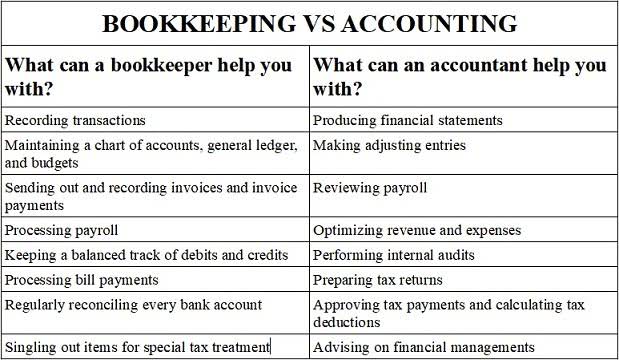
Locking this in early keeps you consistent as you start recording financial transactions. Bookkeeping is http://ved-service.com/hapaglloydag.htm the regular practice of updating a company’s financial records to reflect all financial transactions. Since the information gathered in bookkeeping is used by accountants and business owners, it is the basis of all the financial statements generated. Most accounting software allows you to automatically run common financial statements such as an income and expense statement, balance sheet and cash flow statement. Business owners or accountants can then use these statements to gain insight into the business’s financial health. Evaluate small business accounting services to find the right solution for tracking money, analyzing profitability, and organizing financial transactions for tax time.
What is Small Business Bookkeeping?
A separate bank account is the first step in distinguishing between personal and business expenses and incomes. Bookkeeping becomes more difficult when business transactions are lumped together with personal activity. From payroll taxes to managing invoices, efficient bookkeeping smooths out the process of all your business’s financial tasks and keeps you from wasting time tracking down every dollar.
Keep up-to-date records
Slight differences in how the vendor approaches usage limits, feature add-ons, and users can impact accounting software costs. Bookkeepers record and classify financial transactions, such as sales and expenses. They maintain accurate records of daily https://www.tvsubs.ru/subtitle-92517.html financial activities and manage accounts payable and accounts receivable.
- Simply put, bookkeeping is the process of recording your business’s financial transactions.
- Utilize accounting software to automate tasks and streamline your bookkeeping process.
- At Business.org, our research is meant to offer general product and service recommendations.
- If your business incorporates brick-and-mortar sales with online sales, payroll will be different between the two.
Prepare financial reports
At the beginning of the year, take a look at the list of deductible expenses and determine which categories you’re most likely to spend money in. Consider creating a labelled file folder for each of these expense categories. This way, when you make a purchase, you can immediately file the receipt in the applicable expense category, saving you time when you need to make your expense calculations. If you manufacture goods, your inventory accounting entries will reflect several stages http://ved-service.com/articles-containers/ved-760.htm of completion. If you produce wooden furniture, some of your inventory may be unfinished wood products, furniture currently on the assembly line, and finished pieces. In your ledger, the finished goods inventory will reflect the number of each type you have at any time.
- Bookkeeping is different from accounting in that it is the critical first step in tracking all business activities.
- Consider creating a labelled file folder for each of these expense categories.
- The habits below can make a big difference if you put them in place early on.
- These reports provide valuable insights into your profitability, financial position, and cash flow.
- When doing the bookkeeping, you’ll generally follow the following four steps to make sure that the books are up to date and accurate.
Set Aside an Emergency Fund for Major Expenses

We believe everyone should be able to make financial decisions with confidence. Designed for business owners, CO— is a site that connects like minds and delivers actionable insights for next-level growth. Accurate, up-to-date bookkeeping is the backbone of any successful small business.

How Much Does Small Business Bookkeeping Cost?
- They need to know if the company is making some progress and how they contribute to its growth.
- When you first begin the bookkeeping journey, collect everything you have that could be relevant to establishing financial history.
- Your cash flow statement shows how money moved into and out of your business in a given period.
- Your business’s books are balanced when all of the debits equal (or cancel out) all of the credits.
- If you choose to use double-entry bookkeeping—and we strongly suggest you do!
A good setup ensures that every entry lines up with a specific business activity and gives structure to your financial reports. Double-entry accounting enters every transaction twice as both a debit and a credit. Your business’s books are balanced when all of the debits equal (or cancel out) all of the credits. And since it takes equity, assets and liabilities — on top of expenses and income — into account, it typically gives you a more accurate financial snapshot of your business. Our balance sheet template (pictured below) is a great way to track and analyze your financial health.
It helps you estimate whether a given project or investment would result in more money coming in, or if you’d lose money on the venture. Understanding how to calculate Net Present Value is beneficial for your long-term financial planning. At Business.org, our research is meant to offer general product and service recommendations. We don’t guarantee that our suggestions will work best for each individual or business, so consider your unique needs when choosing products and services. Expand your bookkeeping knowledge by brushing up on the most common bookkeeping errors (and how to avoid them).
-
Modified IRR
The MIRR is primarily used in capital budgeting to identify the viability of an investment project. For instance, if the MIRR of a project is higher than its expected return, an investment is considered to be attractive. The problem with IRR is that it can overstate a project’s profitability.
For businesses with irregular cash flows, the MIRR may not provide an accurate measure of an investment’s prospective return. One notable limitation is that the MIRR requires the user to estimate or define two key rates – the finance rate and the reinvestment rate. These rates can widely vary depending on subjective estimates, thereby influencing the result. If these rates are set unrealistically, it may skew the resultant MIRR and affect the decision-making process negatively. Modified internal rate of return (MIRR) is a capital budgeting tool which allows a project cash flows to grow at a rate different than the internal rate of return. The fundamental difference between MIRR and IRR depends on the assumptions of reinvestment.
MIRR Excel template
Also, the MIRR uses the terminal value of cash inflows adjusted with WACC to the present value. That offers greater flexibility to the management with reinvestments and calculations of MIRR from time to time, unlike the IRR that needs to be calculated before the project commencement. Traditional IRR sometimes may lead to incorrect decisions because it can create multiple rates of return for projects with alternating positive and negative cash flows. This issue arises because IRR does not differentiate between different timing of cash flows and can give equal weight to near-term and far-term cash flows. It is particularly useful for long-term projects because it takes into account both financing and reinvestment considerations, providing a more reliable measure of a project’s long-term profitability.
Cash flows are often reinvested at the cost of capital, not at the same rate at which they were generated in the first place. IRR assumes that the growth rate remains constant from project to project. It is very easy to overstate potential future value with basic IRR figures. When we have calculated the MIRR for any investment or project, it also factors in the company’s cost of capital. Businesses often face the challenge of balancing their financial objectives with their desire to contribute positively to society and the environment.
- Let’s say a company has a project with an initial investment of $1,000.
- For businesses with irregular cash flows, the MIRR may not provide an accurate measure of an investment’s prospective return.
- MIRR, therefore, becomes an essential instrument in strategic planning, capital budgeting, and investment anticipation for the above properties.
- This is often an unrealistic assumption because the rates used in the IRR can be overly optimistic or higher than what’s realistically achievable in the market.
What is NPV?
Technically, IRR represents the discount rate that makes the Net Present Value (NPV) of all cash flows equal to zero. In simpler terms, it’s the rate of return that makes your initial investment break even with future cash inflows. If you want to an easy way to calculate the modified internal rate of return, then check out our MIRR calculator. You can enter any number of cash flows, define a safe rate and a reinvestment rate, then you will instantly see your new set of cash flows along with your MIRR. Modified Internal Rate of Return (MIRR) is a method of calculating the return on an investment with multiple, irregular cash flows. One of the disadvantages of the internal rate of return is that, in the case of projects with unconventional cash outflows, it may calculate multiple IRR figures.
Accounting Rate of Return (ARR)
The total cash inflows at the end of the year adjusted with company WACC is then modified internal rate of return formula used to calculate the MIRR. The modified internal rate of return will also use the WACC adjusted terminal value of cash inflows and compare it to the present value. In short, it can be said that MIRR provides the flexibility to calculate the reinvestment rate from time to time, which is not possible for IRR. In the area of sustainability, accurate profit projection is paramount. Often, sustainability projects can involve significant upfront costs, with returns only realized over a longer period.
Company
The MIRR should be employed when cash flows are unconventional, incorporating a mix of positive and negative values. It is also a more prudent choice when a project’s cash flows are significant and are reinvested at a rate different to the cost of capital. The main limitation of using the modified internal rate of return is that it asks for two additional decisions. These are the determination of the cost of capital, and the financing rate. Business owners may have some hesitation when involving these two additional estimates.
- Utilization of the MIRR guarantees the flow of financial resources toward those projects that provide maximum shareholder value.
- The companies use capital budgeting techniques to analyze different investment options and choose the best one.
- We’ll define the MIRR, look at the logic and intuition behind the MIRR, dispel some common mistakes and misconceptions, and finally, we’ll tie it all together with a relevant example.
- To do so, however, assumes that the financing rate for inflows and the reinvestment rate for outflows are the same as the rate of return inside the investment.
- The MIRR is a powerful investment metric that is gaining in popularity since it eliminates the problems with the traditional IRR calculation and also provides a more realistic measure of return.
Additionally, it is not nearly as widely used as traditional IRR, so it will require more socializing, buy-in, and explaining at most corporations, banks, accounting firms, and institutions. When it comes to financial modeling, and specifically in private equity and investment banking, the standard IRR function is common practice. The reason for this is that transactions are looked at in isolation and not with the effect of then another investment assumption layered in. Since we set the reinvestment rate for MIRR to 0%, we can make an extreme example to illustrate the point. MIRR is a return rate that permits a company to rank investment projects, thereby helping to compare different opportunities. While MIRR and IRR can be used to measure the returns on investment, they contain various assumptions, implications, and levels of accuracy.
MIRR, or modified internal rate of return, is a variation of the IRR metric. Similarly, it shows you what return (expressed as a percentage of the initial investment) you can expect on a given project. Knowing the IRR or MIRR, you can easily compare mutually exclusive investments and choose the one that is most profitable.
The MIRR rectifies this by using a more realistic reinvestment tear-off, which indicates earning more accurate return results. Besides, it is firms that, apart from precise ranking of projects, derive maximum benefits from applying the MIRR rather than the IRR. MIRR is one of the most widely used capital budgeting metrics because it enables comparison of investment alternatives. It allows a more reflective and effective decision-making procedure by ensuring the reinvestment of cash flows at a reasonable rate.
Importantly, this allows you to compare the modified internal rate of returns from different projects that have different timelines. As its name implies, MIRR is a modified version of the standard internal rate of return (IRR) formula. Take the present value (PV) of the project cash flows from the recovery phase (note not the NPV), divide by the outlay and take the ‘ n th’ root of the result. Multiply the result by one plus the cost of capital (1.1 in this case), deduct one and you have the answer. Future value of the net cash inflows from investment assumed to be re-invested at the rate of cost of capital (or a specified re-investment rate where relevant) over the investment period.
As with IRR, the MIRR can provide information that leads to sub-optimal decisions that do not maximize value when several investment options are being considered at once. MIRR does not actually quantify the various impacts of different investments in absolute terms; NPV often provides a more effective theoretical basis for selecting investments that are mutually exclusive. It may also fail to produce optimal results in the case of capital rationing. The discount rate for investment phase is at 13% while the discount rate for return phase is at 11%. In this article, we will cover how to calculate modified internal rate of return (MIRR). This includes the overview, key definition, formula, example calculation as well as advantages and limitations of MIRR.
They were diligent and forthright on both accounts and brought our deal to a successful closing. In order to determine the investment viability of the project, the figure may be later compared with the expected return of the project. Thus, the modified rate of return (MIRR) for this project at different rates of return and investment phases is at 15.35%. Assume having a financial compass that helps you navigate complex investment decisions with precision.
Formula and Calculation of MIRR
That’s exactly what the Internal Rate of Return (IRR) does for businesses and investors. It’s like a financial GPS that tells you whether an investment is worth your time and money. This article will discuss the modified internal rate of return and how it is calculated. Recall that IRR is the discount rate that sets the Net Present Value (NPV) of an investment to zero.
This disclaimer is intended for UK readers accessing this website who should be aware that Moonfare cannot guarantee all information displayed on its website will be relevant or suitable for UK audiences. Moonfare cannot guarantee the information contained on its website is up to date, and makes best efforts to ensure it sources and data are accurate at the time of publishing. If you want to learn more about the present vs. future value of money, check out our time value of money calculator.
Ultimately, the decision between the MIRR and the IRR is not one-size-fits-all. It is contingent upon the cash flows of the investment, the reinvestment rate, financing cost, and the financial context in which the analysis is being applied. Another significant limitation of the MIRR is its inability to account for infrequent or irregular cash flows efficiently. The MIRR assumes that cash flows are periodic or regular, which may not be the case in practice.
-
What is an expense? Accounting Terms
However, there are several nitty gritty to be understood when accounting for your expenses. Cost of Goods Sold (COGS) is the costs incurred while acquiring raw materials and then turning them into finished goods. COGS, however, does not include selling and administrative costs as incurred by your whole company, nor does it include interest expense or loss on extraordinary items. Examples of expenses include rent, utilities, wages, maintenance, depreciation, insurance, and the cost of goods sold.
Allowance for uncollectible accounts is an estimate of the portion of accounts receivable that is expected to become uncollectible. The allowance method represents accounts receivable that a company has justifiable reason to believe it may not collect in full or at all. The concepts of allowance for doubtful accounts and bad debt expenses play a pivotal role in portraying an accurate picture of a company’s financial health. Furthermore, expense reporting plays a vital role in cost management and data-driven decision-making. Analyzing spending patterns will help identify areas where costs can be optimized, leading to better budget management and potentially reduced tax liability.
What happens if the allowance for doubtful accounts is overestimated or underestimated?
Thus, an expenditure generally occurs up front, while the recognition of an expense might be spread over an extended period of time. Under cash basis accounting, an expense is usually recorded only when a cash payment has been made to a supplier or an employee. Under the accrual basis of accounting, an expense is recorded as noted above, when there is a reduction in the value of an asset, irrespective of any related cash outflow. This is achieved by boosting revenues while keeping expenses in check. However, if expenses are cut too much, it could have a detrimental effect. For example, paying less on advertising reduces costs, but it also lowers the company’s visibility and ability to reach out to potential customers.
Bajaj Finserv Limited Regd. Office
Non-operating accounting definition of expense expenses are kept separate from operating expenses from an accounting perspective so it’s clear how much a company earns from its core activities. Businesses are allowed to write off tax-deductible expenses on their income tax returns to lower their taxable income and thus their tax liability. However, the Internal Revenue Service (IRS) has strict rules on which expenses businesses are allowed to claim as a deduction. Operating expenses (OpEx) are the daily costs required to run a business. These expenses are essential for maintaining operations but do not necessarily add long-term value.
- However, there are always some other things to be considered during the accounting of your expenses.
- Setting up clear approval processes for expenses, especially around incidentals like travel accommodations or in-office meals, can play a key role in keeping overhead costs in check.
- The former is directly related to operating the company, while the latter is indirectly related.
- When the cost of sales is subtracted from revenue, the result is gross profit (or gross margin).
More Resources
QuickBooks Online simplifies expense management by automating tasks such as receipt capture and data entry. This helps save valuable time, ensures greater accuracy, and provides insightful reporting features. While it might seem like just another task on your to-do list, expense reports are a key part of how businesses stay organized and make smart money decisions.
It is important to note that not all expenditures are considered actual expenses in this case. Only those costs that are directly related to revenue generation are considered part of the expenses. Fixed expenses are costs that do not change regardless of the amount of revenue generated. Fixed expenses help businesses maintain a certain level of operations each month. Corey’s Food Truck, Inc. is a local food company that delivers sandwiches on the Santa Monica beach. Corey places new deli orders for $100 every Monday to a local butcher.
It’s important to consult a professional tax advisor to learn about what expenses are deductible and not deductible in your or your company’s situation. Yes, a salary is considered an expense and is reported as such on a company’s income statement. Capital expenditures, commonly known as CapEx, are funds used by a company to acquire, upgrade, and maintain physical assets such as property, buildings, an industrial plant, technology, or equipment.
Try Reckon One free for 30 days
It is a contra-asset account, meaning it reduces the overall value of accounts receivable on the balance sheet. Bad debt is the specific amount of accounts receivable that has been determined to be uncollectible and is written off. It is the actual loss incurred when a customer’s account is deemed uncollectible.
Figure 2 graphically illustrates the classification of expenses related to the ordinary activities of the business. When the cost of sales is subtracted from revenue, the result is gross profit (or gross margin). Examples of COGS include direct material, direct costs, and production overhead. Operating expenses consist of the cost of sales, fulfillment, marketing, technology and content, general and administrative, and others.
Companies need expense reporting to maintain accurate bookkeeping, control costs, and ensure compliance with tax regulations. It’s a critical process for tracking employee spending, reimbursing expenses, and gaining valuable insights into business expenditures. Accrual accounting is based on the matching principle that ensures that accurate profits are reflected for every accounting period. The revenue for each period is matched to the expenses incurred in earning that revenue during the same accounting period. For example, sale commission expenses will be recorded in the period that the related sales are reported, regardless of when the commission was actually paid.
- Examples of expenses include rent, utilities, wages, maintenance, depreciation, insurance, and the cost of goods sold.
- However, if expenses are cut too much, it could have a detrimental effect.
- Under cash accounting, the expense is only recorded when the actual cash has been paid.
- Expenses are income statement accounts, and are increased on the debit side of the control account.
- CFI is the global institution behind the financial modeling and valuation analyst FMVA® Designation.
It is important to remember that not all expenditures are considered allowable expenses. An expense in accounting is the money spent, or costs incurred, by a business in their effort to generate revenues. Essentially, accounts expenses represent the cost of doing business; they are the sum of all the activities that hopefully generate a profit. Expenses in accounting are the money spent or costs incurred by a business in an effort to generate revenue.
Even if fixed expenses do change, it would be only by a small margin. Also, fixed expenses are not dependent on the number of units you produce or sell. Under operating expenses, general and administrative costs are those expenses that are incurred while running the core line of your business.
When Corey places his order, he debits supplies for $100 and credits cash for $100. This journal entry records the asset, cash, being used up to generate revenues by making sandwiches. The type of business you run impacts the type of expenses you’ll incur.